
Ohio has stamped, enamelled and printed plates since 1908, and each method left a different object behind. A collector can hold three tags from three decades and feel the change in weight before reading a single character. The story of the design is a story about workshops, presses and paint. A tag from 1915 and a tag from 2020 share a purpose and little else, and the gap tracks the growth of state printing.
Below, the changes run in order, from the earliest state tag to the set on a new car this year. The notes cover the metal, the colour schemes, the slogans and the reasons a standard design gets replaced. Sections on photo checks and on buying old plates close the page. Dates come from state records and club archives, and the two disagree on a few early runs, so treat each border year as a range.
Ohio License Plate Design History
Ohio took over vehicle registration in 1908, and the first state tags came from an enamel shop rather than a print line. The number of cars on Ohio roads was small enough to keep each run short, and a crew of a few dozen people could fill every order for the year.
The first state issue
Enamel was the finish that could take road salt and stay readable. A steel blank received a glassy coat fired in a kiln, and the result felt closer to a dinner plate than to a modern tag. Characters and the state name came through the enamel in a contrasting shade. The state kept a paper record that tied the number to an owner address, and an officer could send a question to Columbus rather than guess. Numbers ran as plain figures, usually three or four of them. A short figure means the car joined the register early in the season, and the state tied the tag to a person in some years. Selling a car could leave the seller with the number and the buyer with a fresh application. A car of a certain age can wear historical plates, and the rules differ from a standard issue.
Registration before the state took over
City halls kept their own vehicle lists before 1908, and the rules differed from one place to the next. Some owners bought a tag from a local supplier, and others cut a rectangle from sheet metal and painted the figures by hand. Those pieces carry a town name instead of a state seal. A local plate can be genuine and still worth very little. Provenance matters more than age in that corner of the market, and a written history from the family raises interest.
What survived and why
Most early tags went into a scrap bin. The state collected the old set at renewal in some years, and a plate left on a car for a decade cracked around the mounting holes. A specimen with intact enamel and a readable number is uncommon for that reason alone. Four details separate the 1908 to 1919 output from everything after it.
- A glassy enamel face that chips in curved pieces
- A number of three or four digits and no letter
- A surface with no reflector and no laminate
- A height or width that fails today’s 12 by 6 inch measure
Design Periods from 1908 to 1959
Three workshops shaped the first half of the century, and each one can be identified by eye. Enamel gave way to a press, the press grew heavier, and the plate took on the shape drivers know today. Size, metal and lettering answer most questions, and the Ohio License Plate size has stayed fixed since the mid 1950s.
Porcelain and the colour rotation
Ohio swapped the background shade with each registration year during the enamel period. The change let a patrol officer judge a tag from across an intersection, and a home made copy rarely matched the current colour. Blue, white and black recur through the surviving examples. Damage reads differently on enamel than on paint. Enamel breaks in curved chips with a sharp edge, and the steel beneath shows as a dark patch. Repaint sits on those chips in a smooth layer that a fingernail can catch.
Stamped steel and raised characters
The 1920s brought a mechanical press and a cheaper blank. A die pushed the figures up from behind, paint went into the low field, and the raised shapes caught the light at an angle. The method lasted six decades. A deep, slightly uneven raise points to an older die. A shallow and perfectly regular raise suggests a die cut in recent years, or a plate pressed from a reproduction tool. The reverse shows the same figures in mirror image, and a maker stamp often sits near one edge.
The 1956 size agreement
American states agreed on a frequent 12 by 6 inch blank in the middle of the 1950s. Ohio signed on, and the wider shape left more space for the characters. A tag stamped after that date should fit a modern frame without an adapter. Hole spacing changed with the shape. A plate of the right size with holes in the wrong place came from a transition year, a different state or a later rework. Check both measurements before paying a frame price.
The Graphic Turn, 1960 to 1999
The second half of the century turned the plate into printed artwork. A reflective base made the characters glow under a headlamp, and a four colour press put a field or a skyline behind the number.
Sheeting and night reading
Glass bead sheeting bounces light back toward its source. A driver sees the tag light up in the beam, and an officer reads it from a distance without a spotlight. The sheeting ages into a warm yellow, which gives a rough date to a plate kept outdoors. Ink printed on sheeting behaves unlike paint on metal. It can lift in patches, and a plate that lost its top film looks chalky under a thumb. That surface cannot be polished back. A state print contract usually runs several years and covers every plate type, from passenger sets to specialty runs. The contractor keeps the artwork files, the sheeting and the dies, which is why a small change to a county line can appear across a whole family of designs at once.
Slogans as design elements
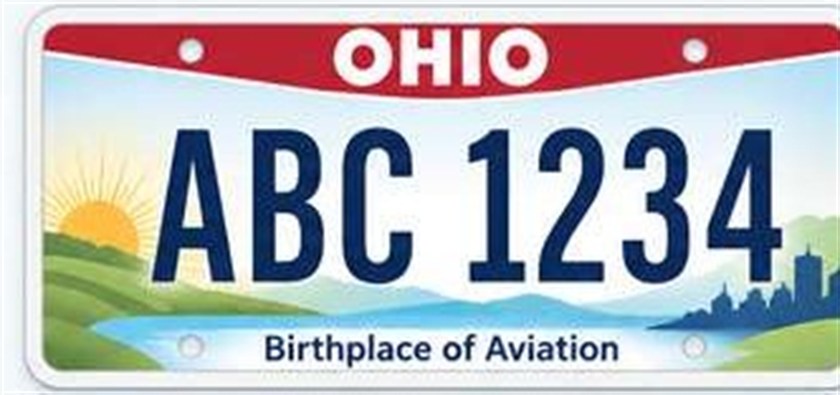
Tourism campaigns left marks on the plate. The Heart of It All arrived in the 1980s and stayed for years, and Birthplace of Aviation carried into later runs. A phrase can date a tag within a couple of years when the rest of the layout is plain. A slogan reflects a change of message as well. When a new governor wants a different line, the artwork changes with it, and the old stock runs out at renewal.
Scenes behind the number
A printed background arrived in the 1990s. The artwork sat behind the number, and the state had to keep the middle of the plate calm enough to read. Busy detail went to the edges and the corners. Colour fades at different rates on a printed scene. One layer can lift as another holds, and the result looks like a bad repaint. Compare the area behind the frame with the exposed field before judging a finish.
Why Ohio Reissues the Standard Plate
A standard issue has a service life, and the state replaces it before the plate becomes hard to read. The schedule is loose, and a change in leadership can move it forward by a year or two.
The cycle and its triggers
Most standard runs last between five and ten years. A new administration, a security upgrade or a wave of complaints about wear can each start the process. The BMV shows the artwork before the first plate ships, and the old design stays legal until renewal. Two designs share the road for a year after a switch. A car keeps its old set until the registration date, and a driver who renews early can sometimes choose which design arrives.
- Laminate that peels at a corner
- Ink that fades faster than the ten year target
- A feature that a camera or a counterfeiter defeats
- A new administration with its own message
- A print contract that comes up for tender
What a refresh costs and saves
Artwork, dies and a first run cost real money, and the figure only works since millions of plates share it. A longer run lowers the yearly cost per plate, and a shorter run keeps the design ahead of copies. A new design can fix a fault found in service. A county line placed too near the characters, a laminate that lifts in heat or a shade that fades too fast can all be corrected at the next artwork.
Security features and the reader
Camera systems on patrol cars changed the brief for a designer. The characters need a plain background, generous spacing and a font that a machine can segment at an angle. A busy illustration behind the number can defeat a reader on a wet night. The state adds covert marks as well. A pattern in the sheeting, a tiny symbol or a colour that shifts under a certain lamp helps an officer test a suspect plate. None of those marks survive a phone photo.
Materials, Ink and Laminate
The blank evolved more slowly than the artwork, and the change is easy to feel. A 1950s steel plate and last year’s aluminium plate differ in weight, sound and the way they fail.
Steel, aluminium and the magnet test
A magnet clings to steel and slides off aluminium. Rust blooms red on steel, and aluminium leaves a white powder at a scratch. The industry moved in stages, and a single year can hold both metals as old stock ran out. Tap the plate with a fingernail. Steel gives a dull thud, and aluminium rings. A very light plate with a grey surface and no rust is likely aluminium that lost its paint. Aluminium changed the bracket as well. A lighter blank needed less support, and a plate that used to sag on two bolts could sit flat in a plastic frame. Rust stains on a bumper became rarer as the metal changed.
Flat print and raised characters
A raised figure stands above the face and throws a shadow when the plate is tilted. A printed figure sits flush, and the artwork runs beneath it in one pass. A raking light from a desk lamp separates the two in seconds. Flat print allows a photographic background and costs less per unit. The weakness is a surface that scratches and a film that can lift. A jet wash held too close is the usual culprit.
Fade, chips and laminate
Sun, salt and heat attack a plate in different ways. Ultraviolet light bleaches the ink, salt creeps under a chip and heat softens the film until it wrinkles. A tag kept in a shed holds its colour far better than one that faced four winters of road brine. Harsh cleaning ruins more plates than weather does. A scouring pad strips the surface and leaves a pale patch that no polish can fix. Plain water and a microfibre cloth are enough.
Colour and Slogan Changes
A colour scheme carried information in the early years. The shade told a viewer which registration year a car belonged to, and a mismatch was a reason to stop the driver.
Colour as a year marker
The enamel years ran on a yearly rotation, and the steel years kept to two shades per issue. A third colour on a plate from the middle of the century points to a repaint. Paint that ends before the rim is another sign. Odd shades can still be original. Blue goes grey and red goes brown under sun, and a plate that hung on one wall fades on the exposed side only.
Slogans that came and went
A slogan is the easiest feature to date and the easiest to fake. The Heart of It All belongs to the 1980s, and Birthplace of Aviation belongs to later runs. A phrase on the wrong background is a warning sign. Letter spacing helps. A copy often sets a popular phrase in a font that does not match the year, and the gap between letters gives it away at arm’s length.
What a colour change tells you
A new shade can mark a fiscal year rather than a calendar year. Some issues ran into the next registration period, and a tag can carry a year ahead of the car model year. Read colour with the stamp and the number. One clue can mislead, and three clues together rarely do.
Reading a Design from a Photo
Most old plates sell through a photo, and the wrong angle hides the features that settle a date. A buyer who asks for the right shots avoids most surprises. A set of Ohio license plate images from a reference site is the fastest way to match a layout, and a club archive can supply the rest.
What to request
Ask for a straight face shot in daylight, a shot of the reverse and a close view of one corner. The face shows the layout, the reverse shows the stamp and any maker mark, and the corner shows the edge and the film.
- Face shot straight on, with daylight and no flash
- Reverse shot with all mounting holes visible
- Corner close up showing the edge and any film
- A ruler or a coin for scale
Clues in the corners and the back
A rolled edge and a rounded corner belong to a modern blank. A square corner with enamel missing in flakes belongs to the early years. A hole outside the factory pair means a later bracket or a home repair. The reverse tells you how the figures were made. Raised characters show as hollows, and a flat print leaves a smooth back. A maker mark, a steel gauge or a date stamp on the reverse can confirm a year.
Mistakes that mislead
Flash flattens a faded face and brightens a dull one. A wide lens stretches a plate near the frame edge, which throws off the proportions. Ask for the shot on a plain surface with the camera square to the plate. A seller who refuses a straight shot is worth skipping.
| Feature | What it shows | Where to look |
|---|---|---|
| Year stamp | Issue year, when the plate carries one | Top or bottom edge |
| Metal | A rough production window | Magnet test or weight in the hand |
| Character method | Stamped metal or flat print | Tilt the plate under a lamp |
| Size | Before or after the mid 1950s | Tape measure across the face |
| Number pattern | A place in the series | Count the letters and digits |
| Slogan | An administration or a campaign | Line above or below the number |
| Edge film | A modern laminate | Corner where a clear layer lifts |
| County line | Registration county and period | Top edge or a corner block |
Design Timeline at a Glance
The table below sets the periods beside the feature that separates each one. Read it as a first filter, then confirm against the sections above.
| Period | Years | Key feature |
|---|---|---|
| Enamel beginnings | 1908 to 1919 | Porcelain face, short number, a new colour each year |
| Stamped steel | 1920 to 1945 | Raised characters, two colours, county code in some series |
| Postwar shape | 1946 to 1959 | A standard footprint and a brighter paint |
| Reflective years | 1960 to 1979 | Sheeting that reads at night, flat colour fields |
| Slogan and scene | 1980 to 1999 | Printed background, Heart of It All, anniversary issues |
| Graphic standard | 2000 to 2020 | Full colour print on aluminium, laminate over the ink |
| Current cycle | 2021 to today | Sunrise scene, camera friendly layout, clear film |
Collecting Old Ohio Plates
Price in this hobby rests on condition, scarcity and proof of history. A frequent plate from a long run sells for a few dollars, and a scarce pair in fresh condition can reach three figures. Local demand matters too, and a plate from a nearby county sells faster than one shipped across the country.
Condition grades
Look at paint, straightness and the height of the characters. A straight plate with most of its original colour and a crisp number sits at the top. Bends, rust holes and touch up paint push it down the scale. Scarcity comes from two figures, how many were stamped and how many survived. A short run with a poor survival record beats a long run every time, and a matching pair beats a single from the same year.
Copies and restrikes
Modern copies are easy to spot in the hand. The face is flat, the edges are too clean and the thickness is uniform. A dealer with five identical plates from a scarce year has a stack of reproductions. A forger can add wear with sandpaper and paint, and the result usually looks too regular. Check the reverse for a maker mark and for the hollows that a real stamp leaves.
Storage and display
A dry wall away from a window is the best home for a plate. A frame with glass keeps dust off the face, and a backing board stops a bend. Damp air damages steel and aluminium in different ways. Swap meets, estate sales and club auctions supply most of the market. A box lot can hide one good plate among a dozen frequent ones, and a club newsletter often lists a fair price before a dealer sets one. Three habits keep a plate intact.
- Hang from the original holes with a clip or magnet
- Dust with a dry cloth and rinse only when needed
- Keep away from damp, sun and a hot radiator
Avoid drilling a new hole. The original mounting points are part of the object, and a fresh hole costs value. Hold an enamel plate by the rim, since flexing can crack the glass layer.
Frequently Asked Questions
Five answers cover the dates, the colour changes and the copies that worry a first buyer. Each answer names the rule or the record behind it, and the sections above carry the longer version.
When did Ohio start issuing plates?
The state took over in 1908 and bought enamel tags from a contractor. Numbers were short and ran as plain figures. Cities had handled their own lists before that year, and a local tag can look similar and still carry a town name.
Why did the background colour change each year?
A new shade made last year’s registration obvious at a glance and gave a patrol officer a simple test. The practice ran through the enamel period and faded once reflective sheeting made plates easier to read at night.
What makes a reproduction easy to spot?
A flat face, a uniform edge and a clean back. An original has uneven stamp depth, a maker mark and paint that sits below the raised figures. Several identical examples from a scarce year are a clear warning.
Is every old Ohio plate 12 by 6 inches?
No. That footprint became frequent in the mid 1950s. Plates from the enamel years and the early steel years can be taller, shorter or wider, and the mounting holes moved with the size. A frame bought for a modern tag can need an adapter or a second set of holes.
Why replace a design that still works?
Wear and legibility drive the decision. A plate in service for a decade fades, peels and loses contrast for a camera. A new run adds a security feature and gives the state a fresh message on millions of cars.