Ohio license plate questions arrive with a deadline attached. A seller wants cash today, a renewal notice sits unopened, or a plate on the road needs checking. This page handles them in the order most drivers meet them, starting with how to get plates, how to check a plate, what each stage costs, and which rules decide the answer. Start where your question starts, since each heading stands on its own.
Ohio license plate rules moved in small increments across five years. The Sunrise in Ohio design replaced Ohio Pride at the end of 2021, a blackout plate worked through the legislature, and the rear-only rule still catches drivers who move in from two-plate states. Each heading below covers one task and names the office that handles it, so a phone reader can jump straight to the section that matters.
How to Get an Ohio License Plate
Plates arrive through a registration at a deputy registrar, and the paperwork depends on who sold the car. A dealer submits most of it; a private sale puts the work on the buyer. Count on one visit for a dealer sale and two when a private title needs review. Bring every document listed below in one folder, since a missing item sends you back to the counter. The state page for this process stays at the address below.
https://www.bmv.ohio.gov/registration-titles.aspx- Bring proof of ownership. A dealer supplies a memorandum title. A private seller signs the title over, and a bill of sale states the price and date.
- Show insurance for that vehicle. The card must carry the VIN, and the VIN should match the title.
- Complete a VIN inspection. Ohio asks for one on an out-of-state title, and some counties ask on in-state transfers.
- Visit a deputy registrar. Pay sales tax, the registration amount for the vehicle class and the plate fee.
- Collect the plates and registration card. Most offices print both at the counter. A mailed title can arrive later without holding up the plates.
What to bring to the deputy registrar
Buyers forget documents more often than they forget money. The counter asks for the same set every time. The steps for a full license plate lookup sit in their own section, with the fields each result returns.
- Signed title, or the memorandum title from a dealer
- Bill of sale with the price and date
- Proof of insurance showing the VIN
- Photo ID for each buyer
- Payment for sales tax, registration and the plate fee
- Lease agreement and a signed authorisation from the lessor, for a leased car
An out-of-state title adds the VIN inspection, and some counties ask for the previous registration.
What it costs at the counter
Three charges land on the receipt. Sales tax on the purchase price comes first, then the registration amount for the vehicle class, then the plate fee. Local permissive taxes vary by county, which is why two neighbours can pay different totals for the same car. The fee table below lists every plate charge in one place.
Timing, mail and temporary tags
Most county offices print plates on the spot, and the registration card follows in the same envelope. A title that needs correction moves to Columbus for review, which can add two to three weeks. During that gap the temporary tag carries the car, and a copy of the bill of sale in the glovebox answers most questions at a roadside stop.
How to Check an Ohio License Plate
A plate check starts with the characters on the plate, not with a name. Ohio links each plate number to a vehicle record, and public tools return vehicle data rather than personal data. The six stages below work on a phone, in a parking lot, with no account needed. Each one takes under a minute, and the last stage tells you when to stop checking and call an office instead.
- Copy the plate exactly. Current standard plates carry six characters in an ABC 1234 pattern. A 0 typed as O, or a 1 typed as I, is the usual reason a search returns nothing.
- Set the state to Ohio. Plate formats repeat across states, and a search without the state can pull a record from another jurisdiction.
- Choose the answer you need. Vehicle identity, vehicle history or owner identity. The first two come from a plate check; the third stays restricted.
- Run the check. Free tools return a VIN and basic specs. Paid reports add title, salvage auction, insurance and odometer entries.
- Decode the VIN. A clean plate-to-VIN match confirms the vehicle. A mismatch points to a swapped plate or a data lag.
- Confirm anything you plan to act on. A private sale deserves a title check and a recall check. A hit-and-run belongs with local police.
Read the result correctly
A plate that returns a different make than the seller advertised is a warning, not proof of fraud. Plates move between vehicles, records update on a delay, and a recent transfer can leave the old entry visible for weeks. Compare the VIN on the car’s dashboard and door jamb against the VIN in the result before treating it as a fault.
What the free tools return
A free check usually returns a short set of fields.
- VIN plus the decoded make, model and model year
- Body style, fuel type and engine size
- Recall count and a title-brand flag, on some tools
None of them return a name, an address or a phone number. A page that offers those details for a plate is selling a subscription or collecting card data.
Ohio License Plate Fees
Plate charges and registration charges sit on separate lines. The table covers plate transactions from the BMV fee schedule; registration, local taxes and county fees sit on top. Read it as a quote for the plate itself, not for the whole visit. A county can add its own tax, and a card payment can add a service charge, so the total at the counter runs higher than the plate line suggests.
| Plate transaction | Fee | Notes |
|---|---|---|
| Standard plate, set of two | $7.50 | Paid once at issue |
| Standard plate, single | $6.50 | Rear-plate-only vehicles |
| Replacement plate, one | $15.00 | Lost, stolen or damaged |
| Replacement plate, two | $16.25 | Both plates replaced |
| Retain stock number | $10.00 | Keeps current characters |
| Plate and registration transfer | $9.00 | Same owner, new vehicle |
| Temporary tag, 45 days | $23.00 | Private sale |
| Personalized plate, annual | $50.00 | On top of registration |
What the fee table does not include
Four charges sit outside the plate line.
- Sales tax on the purchase price
- Registration for the vehicle class
- County permissive tax, set locally
- A deputy registrar or card service fee, where the county adds one
A Franklin County buyer who keeps an old plate pays the transfer fee, the registration amount and local tax. A personalized request adds its own annual fee. Counties collect their own permissive tax, and a few add a deputy registrar convenience fee. A buyer who moves inside Ohio keeps the plate and pays a small replacement charge when the county name changes. A buyer who moves out of state surrenders the plate and asks the new state for a fresh registration.
Ohio License Plate Design
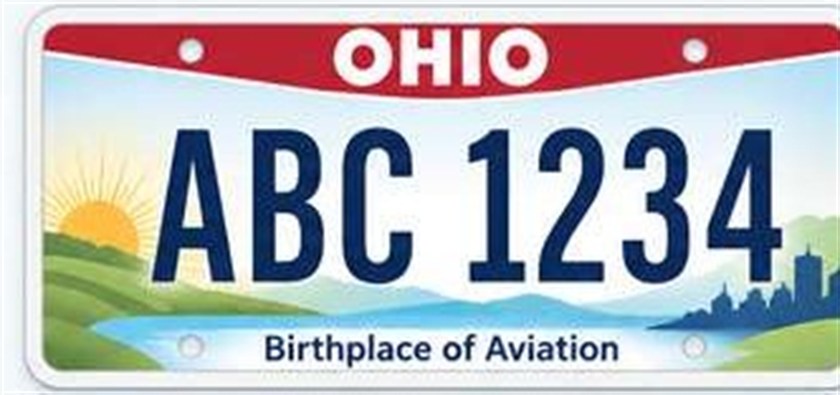
Ohio has refreshed its standard plate twice since 2001, and the design on the road today is the Sunrise in Ohio issue that arrived in December 2021. The table below breaks the current plate into its parts, and the illustration shows how they sit together.
| Element | Current plate | Note |
|---|---|---|
| Design name | Sunrise in Ohio | Issued from 29 December 2021 |
| Background | Light sky, sunrise over fields | Replaced the Ohio Pride plate |
| County name | Printed across the top | Follows the county of registration |
| Characters | Six, ABC 1234 pattern | Screen printed in black |
| Size | 12 by 6 inches | Same as every US plate |
| Material | Aluminum, flat print | A peeling plate needs replacement |
The current Sunrise in Ohio plate
The Sunrise in Ohio design replaced the Ohio Pride plate at the end of 2021, and both designs still appear on the road until each registration renews. The BMV refreshes the standard design on a five-year cycle or when a new governor takes office, so another change is possible before 2030. A blackout plate option moved through the legislature in 2025, and the order details sit with the BMV.
Reading the county name
Ohio prints the county of registration along the top of the standard ohio license plate. The word is a label, not a code, and it changes when a vehicle moves to a new county and the owner orders a replacement. Older issues carried a two-digit county number in some formats, which is where county-code questions start.
Plate number format
Photograph the plate in daylight, flat on, with the county word visible, before sending it to a buyer or an insurer, and keep the photo with the bill of sale. Ohio plates measure 12 by 6 inches, the same as every other US state. Aluminum stock, flat printing and a clear laminate keep the design readable through salt, sun and car washes. A bent plate that will not sit flat needs replacement, and so does one with a peeling laminate over the characters.
Types of Ohio License Plates
Ohio issues one standard passenger plate plus a long list of specialty ohio license plates. Each type carries its own eligibility rule, fee and renewal cycle. Most drivers stay on the standard plate and never look further. The alternatives start to matter when a vehicle class, a cause or a personal message changes the choice, and the price can double at renewal.
Standard, personalized and specialty
- Standard passenger plates for cars, SUVs and light trucks, one on the rear
- Personalized plates up to seven characters, with an annual fee on top of registration
- Specialty plates for colleges, teams, causes and wildlife designs
The standard plate covers most vehicles. Personalized requests pass a banned-list check before the BMV prints them. Many specialty designs add an annual contribution to the organisation behind the plate.
Historical, motorcycle and trailer
Historical plates suit vehicles 25 years old or older and limit driving to events and maintenance runs; model-year plates let a car wear a plate from its build year. Motorcycles take a smaller single rear plate, and personalized bike plates follow the same seven-character rule. Trailers and RVs register by weight, and many trailers qualify for permanent registration. Renewal follows the plate, not the paperwork. A plate transferred to a new car keeps its number and its renewal date, and the BMV credits the remaining term when the owner pays the transfer fee. A plate that sits unused for more than a year can lapse, and the number may return to the pool for someone else to request.
Renewing and Replacing Ohio Plates
Registration renews every year or every few years, depending on the term chosen at issue. The plate stays with the vehicle, and the sticker proves the registration is current. Ohio mails a notice about six weeks before the expiry date. Miss that date and the fee climbs; ignore it long enough and a traffic stop adds a ticket. The stages below cover the normal renewal, the sticker rule and the cases where a plate needs replacing.
Sticker placement
Ohio prints the month and year on one sticker for most vehicles. It goes on the rear plate in the marked spot and must not cover the characters or the county name. Clean the plate, press the sticker flat, and drop the frame if it hides the corner. Renewal runs through one of three routes.
- OPLATES online, with the plate number or the PIN from the notice
- Mail, with the notice and a cheque or money order
- A deputy registrar counter, where the sticker prints on the spot
Online renewal sends a confirmation to the email on file, and the sticker arrives in about a week. A payment that fails leaves the registration open, and the notice keeps the old expiry date until the card clears. Drivers who renew by mail should post the notice ten days before the deadline, since a cheque that arrives late carries the same late fee as no payment at all.
Lost, stolen or damaged plates
A lost sticker can be replaced at a deputy registrar for a small fee. A damaged or peeling plate needs a replacement, and the old plate goes back to the BMV. Report a stolen plate to police before ordering a replacement, so the old number cannot be tied to a new driver. E-check counties add an emissions test before renewal, and a failed test blocks the registration until a repair and retest clear.
Registration and Moving to Ohio
Where the car came from decides the paperwork. A dealer sale, a private sale and an out-of-state move each follow a different path. All three share the same counter and the same fee schedule, and they differ in who signs what. A missing signature on a private title costs more time than any other mistake at this stage.
Dealer sale
The dealer submits title work, collects tax and issues a temporary tag. Plates and the registration card arrive by mail in roughly two to four weeks. Check the memorandum title against the VIN on the car before leaving the lot, and keep the buyer’s order with the tag number. A lease adds one more layer. The lessor holds the title, and the lessee registers the car in Ohio with a signed authorisation form supplied by the leasing company. Military members stationed in Ohio can keep a home-state registration in some cases, and the BMV office confirms which rule applies before plates are issued.
Private sale and out-of-state
A private sale puts title, tax and registration on the buyer. Bring the signed title, a bill of sale, proof of insurance, the VIN inspection and payment to a deputy registrar. New residents register within 30 days of establishing residency, and an out-of-state title needs a VIN inspection. Ohio issues one rear plate for passenger vehicles, so a front bracket stays empty.
Ohio Plate Laws and Privacy
Display rules and privacy rules answer two different questions about the same plate. One decides whether a plate can draw a ticket, the other decides who may see the name behind it. Both come up after a crash, a parking dispute or a request for owner details.
Front plate rule
Ohio requires one plate on the rear of passenger vehicles, a change that took effect on 1 July 2020. Commercial tractors still carry a front plate. Ohio Revised Code 4503.21 requires a clean, legible plate mounted where the manufacturer placed it. A frame that hides the state name, the county or any character breaks the rule, and so does a tinted cover. Penalties start at a minor misdemeanour. A plate light that fails at night draws the same warning as a dirty plate, since the rule covers visibility.
https://codes.ohio.gov/ohio-revised-code/section-4503.21What the DPPA blocks
The Driver’s Privacy Protection Act limits who can pull a name from a plate, and Ohio adds its own limits under 4501.27. Police can run a plate during a stop; a member of the public cannot buy that same record without a permitted purpose. Permitted uses cover a short list.
- Law enforcement and courts
- Insurers and licensed investigators
- Towing, salvage and repossession work
- Requests backed by written consent
Ohio Plates Beside Neighbouring States
Drivers who cross a state line notice the differences at a toll booth or a parking lot. Ohio sits between one-plate states and two-plate states, and the contrast covers most of the questions that arrive after a move.
One plate against two
Ohio issues a single rear plate for passenger vehicles, and several neighbours still issue a front plate as well. A car that moves in from Michigan or Kentucky arrives with a front bracket that stays empty, and a car that leaves Ohio for a two-plate state needs a second plate that the state never printed. The county office in the new state handles that order. A visitor driving through Ohio keeps the plate from home, and an officer judges the display by the home state rule for most questions. A cover that hides the characters still draws a stop, since legibility sits at the centre of every state statute.
Specialty and personalized rules nearby
Personalised character limits vary by state, and a phrase that fits seven spaces in Ohio can run short in Indiana or long in Pennsylvania. Availability is local as well. A combination free in Ohio may sit on a car two hundred miles east, and the check has to run against the state where the plate will live. Specialty programmes differ in the same way. A college design that exists in Ohio may have no equivalent across the line, and a cause plate from another state cannot transfer into the Ohio programme. A driver who moves keeps the memory and orders a fresh design.
What a visitor should check
Three items cover a short trip or a long move.
- The plate display rule in the state where the car is registered
- The registration expiry, since a sticker from home stays valid on a visit
- The local rule for covers and frames, which changes at the border
A move changes more than the address. Registration, title, insurance and the plate itself all restart in the new state, and the Ohio plate goes back when the old registration closes. Keep the cancellation letter, since an insurer or a toll authority may ask for it months later.
Frequently Asked Questions
These five come up most at a county counter and in search, and each maps to a section above for the longer version. Answers stay short, with the office or rule named so the detail can be checked at the source.
How much does a replacement plate cost in Ohio?
$15 for one plate and $16.25 for two. Keeping your current characters at replacement adds $10 to either price, and the deputy registrar collects the fee at the counter. Report a stolen plate to police before ordering, so the old number is flagged.
Does Ohio require a front license plate?
No. Passenger vehicles carry one rear plate since 1 July 2020, and only commercial tractors still need a front plate. A front plate from another state stays legal on a visiting car, and a frame that hides the county name can still draw a warning.
Can I transfer my Ohio plates to another car?
Yes, when the plate moves to another vehicle you own. Bring the title, proof of insurance and payment for the $9 transfer fee at a deputy registrar. The plate keeps its number and renewal date, so the remaining term carries over.
How long is an Ohio temporary tag valid?
45 days for a private sale, issued at a deputy registrar for $23. A dealer tag runs on its own schedule, and the expiry date prints on the tag itself. Driving past that date turns a paperwork delay into a traffic stop.
What does the county name on my plate mean?
It shows the county where the vehicle is registered. Move counties, order a replacement plate, and the new county name appears. Older issues carried a two-digit county number, which is where most county-code questions start.